Monday, August 2, 2010
The Waste Land by Simon Acland
Written by Simon Acland
Charlwood Books
384 pages
Reviewed by Elaine Simpson-Long
Underneath the title of this book on its front cover are the words An Entertainment. The reader is therefore given a clear message that this book is meant to be just that, perhaps not to be taken too seriously and to be read with enjoyment and pleasure. As this reader did.
The author used to be a venture capitalist. His company was sold in 2007 and he took the opportunity to turn to writing. As you do. Apparently Simon Acland studied thirteenth French Grail romances at University from whence stems his interest in the myths and legends surrounding the Holy Grail. For this I am most grateful and also grateful to the capital ventures as I am making the assumption that they have enabled him to write this terrific book for our delight.
The Waste Land opens in St Lazarus College where the Master is waiting the arrival of the Best Selling Author (always referred to in this way and with capital letters too), an erstwhile member of the university who has written several successful books. As the BSA (which is how I will refer to him from now on), was not a brilliant student or academically gifted it rather sticks in the craw that he is being welcomed in this way, but times is hard and money is needed and the Master is rather hoping the BSA will gift a donation to prop up the college. Hence the invitation and the dinner.
It soon becomes clear that this is a misplaced hope as the BSA does not appear to have any money to spare at all and also admits "I seem to have run out of ideas. I can't get any good plots going". And then up pipes the disfigured and insignificant Research Assistant who reveals that he has made an extraordinary discovery in the library.
"I found a parchment manuscript, written partially in old Greek, insterspered with medieval Latin....it was stuck in the middle of an unintersting palimpsest....it seems to be the journal of some Crusader monk who claims to have discovered the truth of the Holy Grail. It is an extraordinary story, as gripping as anything that our honoured guest has ever devised"
The Master seizes on this as an answer to their problem "the manuscript, college property of course, could provide our friend here with his new plot. He will write it in his inimitable style and share the royalties with the college...."
And off we go. The story of Hugh de Verdon, monk turned knight, during the historical events of the First Crusade is totally fascinating and gripping. The Crusades, supposedly a Holy War (where have we heard that before) was bloody and brutal and the narrative is in the first person so we have Hugh's thoughts and feelings on his adventures. As a young boy he had been placed in a monastery by his mother who had been widowed and suffered the death of her other two sons in battle and wishes Hugh to avoid such a fate. He is here for several years but as he reaches maturity he yearns to leave and go to battle, to fall in love, to experience real life and eventually gets his wish when he joins the company of Godfrey de Bouillon, Duke of Lower Lorraine and finds himself, initially employed as a secretary cum scribe to his master and then, later, a fighting knight with his own horse, suit of armour and privileges.
Then the story really takes off and we follow Hugh on his journey to the Holy Land, his love for Blanche (yes there is a beautiful heroine as well), his involvement in the political machinations between Godfrey and his brothers, his daring escapades and then the eerie experience of falling into the hands of "Hasan i Sabbah, Grand Master of the Nizaris, Lord of the Assassins known by some as the Old Man of the Mountains"
"His white robes hung down behind like the wings of some vast snowy owl. A cruel hooked nose beaked from his face between two hooded black eyes...........the black centre of each eye was ringed by a bizarre yellow circle inside the iris, accentuating the whole impression of some great bird of prey".
Hasan spends his life in his library, reading and learning, sending his Assassins out to do his bidding and he has decided after reading Ovid - Metamorphoses that it contains the recipe used by Medea to give Jason's father new life and vigour. "Allah has sent me the perfect subject on which to test this experiment. Tomorrow we shall try Medea's medicine out on you".
Right, I am going to stop here else I will be setting out the entire plot and story and this post will be very long indeed. You need to get a copy and read it yourself. I loved this book. I will be honest and say I wasn't totally sure when it dropped through my letter box, but if there is one thing I have learned over four years of Random Jottings, it is that I should not make hasty judgments. Pretty sure I have discarded some books that were worth my attention in the past so I am more careful these days and so I gave the Waste Land my total concentration and was well rewarded.
It is exciting and thrilling and Simon Acland is steeped in this period of history and really knows his stuff. The Crusades and Crusaders are a fascinating subject and have this romantic aura about them which we know is misplaced, but this lingers on. I think we have been rather blinkered as to their brutal reality by the capture of King Richard, the minstrel Blondel, Robin Hood etc etc so that the Crusades have this air of glamour and derring do attached when, in reality, it was all pretty vile and self seeking as most wars, holy or otherwise, turn out to be.
And yet, despite my knowing all this, I simply reveled in this book and enjoyed every page and what made it even more enjoyable was the juxtaposition of the narrative of Hugh de Verdon and the internal squabbling and jealousies of the Fellows of St Lazarus. The research assistant soon rues the day he mentioned his discovery and watches while his find and hopes of academic glory are taken away and sacrificed to the financial needs of the college. Events in the story begin to mirror events in the university, the near death of the BSA in an accident, another fellow being burned to death in his bed, another with mysterious stomach pains which turn out to be poison - who is behind it all? The police are called in and as I have been recently reading the crime novels of Edmund Crispin set in Oxford with the professor and sleuth, Gervase Finn, this added to the pleasure of my reading of this book.
The story of Hugh could have stood well on its own as a straightforward historical novel but the author has added an extra dimension to the Waste Land by this device. It is also witty and funny and comes as a refreshment to the reader who has become totally immersed in the dreadful brutality of the war and Hugh's own sufferings. The ending leaves the door open for the Best Selling Author to write a sequel to the successful outcome of this plan by the Master of the College and I am delighted to see that this will be forthcoming, The Flowers of Evil. I await my review copy in due course.........
Hugely enjoyable, engrossing and engaging from start to finish I loved this book and it will be going on my list of Best Reads of 2010. I like the conceit behind it all and the slight tongue in cheek style in the depiction of the squabbles and pettiness of the Dons, each certain in his own intelligence and superiority to his Fellows. Last year I dined in Hall at St John's in Cambridge and, while I found all the Fellows I met there to be delightful and charming, I could not help but think about them when reading the Waste Land.
Wonderful stuff and do check out this link below - the author talking about his book. Fun and he is dressed as a Crusader as well.....
http://www.meettheauthor.co.uk/bookbites/1915.html
Wednesday, April 1, 2009
A Perfect Waiter
by Alain Claude SelzerBloomsbury Publishing
211 pages
Reviewed by Elaine Simpson-Long
This book was sent to me by Bloomsbury. I must say that those doom mongers who said that after the last Harry Potter book Bloomsbury would find it hard to survive, are doing this house a disservice as they seem to have an endless stream of fascinating books published and ready to come in 2009 and this is one of them.
A Perfect Waiter tells the story of Monsieur Erneste. He is the perfect waiter, discreet, efficient, non intrusive and has been a fixture at the Restaurant am Berg for sixteen years. Before that he worked at a grand hotel in
His was an unplanned existence. Any plans affecting him were made by others, people who knew their business and to whom he willingly deferred...having always been alone, he was barely conscious of his solitude. At night when he sank wearily into bed he felt safe...he had no reason to wish for a change in his circumstances...he could have gone on living like that for many years more.
And then one day, this ordered life is plunged into turmoil when he is sent down to meet the steamer crossing the lake bringing new staff for the hotel, two laundry maids and a new waiter who he will train. He meets Jakob and immediately falls in love.
Jakob shook Erneste's hand and introduced himself...the handshake seemed to say "Here I am, having come here purely for your sake" and the little world in which Erneste had so blithely installed himself collapsed.
And so a feverish love affair begins in the hot drawn out summer days where the febrile pre-war atmosphere heightens the senses as the cataclysm is awaited. The room Ernest and Jakob share is high under the eaves and is hot and sweltering and this sense of heat and tension adds to the passion they feel for each other. This is a fairly explicit book, but I did not find it offensive in any way and the reader knows that this intensity cannot last and that Erneste is destined for heartbreak. So it happens as one day he returns to the room unexpectedly and finds Jakob with one of the guests, a wealthy writer who has fled
Years pass and Erneste's life as the Perfect Waiter continues, alone and solitary, he has managed to conceal his heartbreak and carve out an existence for himself and then one day, out of the blue, comes a letter from Jakob, he is in trouble and is asking for Erneste's help. He is to go and see the writer, Klinger, whose lover he was and who now lives in Switzeralnd and ask him for money, Jakob is desperate.
Erneste is in turmoil as his life is turned upside down and his memories of Jakob and his betrayal are revived but he cannot say not to Jakob and finds his way to Klinger's house. He now lives alone, a widower, his daughter in
Used to gay relationships nowadays, it is easy to forget that being homosexual at the time of the setting of this novel, was regarded as perverse and immoral and one night when Erneste goes what would now be called "cottaging" he is set upon by thugs who despise his kind, and he is beaten badly. He manages to get back to his small apartment, knowing that the police will not be sympathetic to his plight and that he can seek no redress. He curls up and heals himself, like an animal and for the first time in his life, has to take time off work. Though this is a horrible episode it has a rather uplifting moment as he returns to work, scared that he might lose his job and finds an unexpected reception:
He was surprised to find that his reappearance was greeted with pleasure, not only by the manager but also by his fellow waiters, even by the chefs and kitchen hands. Although none of them slapped him on the back, he could tell from their friendly faces that they had missed him a little.
So, not so unloved or unappreciated after all.
When reading this book I thought of Aschenbach in Death in Venice staying in a grand hotel and becoming obsessed with the youth and beauty of Tadzio (who surely knew of this love and encouraged it), of the butler in Remains of the Day, repressed and always the perfect servant, the setting reminded me of Hotel du Lac and the feeling of a world encapsulated for a short period of time in one place which, for the purposes of this novel, is isolated from the happenings in the world.
A review in The Guardian says of this book, "The real perfect waiter of the title is, I suspect, the author himself. Like his hero he is unobtrusive and alarming in equal measure, he does his job not just with great polish, but with real heart".
An elegant, quiet, deeply felt book. Oh dear, how love does make fools of us all.
Mr. Perrin and Mr. Traill
by Hugh Walpole
Capuchin Classics
198 pages
Reviewed by Elaine Simpson-Long
Gosh, what a simply terrific book. Sent to me last month by Capuchin Press and opened it up knowing zilch about the book, story or the author, save that I used to see Hugh Walpole's books on the shelves at a library I used to work in light years ago when the world was young and I wore a mini-skirt. So when this landed on my doorstep I had absolutely no idea what to expect.
I do find books with a school background fascinating. It is similar in many ways to a murder mystery in a country house, a disparate group of people all under one roof, all cooped up together, no escape and this is the case in Mr. Perrin and Mr. Traill who are both teachers at a second rate school, Moffats, in Cornwall. The stifling, claustrophobic atmosphere inside the school a total contrast to the wild Cornish coastline representing the clear pure outside air as opposed to the poisonous atmosphere within.
Mr. Perrin is a failure and he knows it. Unmarried, unattractive, pompous and boring, he lives at home with his old mother during the holidays. The rest of the year he is a teacher where his colleagues are equally aware that they are trapped in their posts and will never get away. Bitterness, dislike and irritation abound as the staff, cooped together under the authority of a vicious and bullying headmaster, rub up against each other and small matters assume shattering importance.
Into this school comes Mr. Traill. Freshly graduated from
As the weeks of the term wear on the petty jealousies begin to emerge. Mr Broadland, one of the long term teachers has warned Traill of what will happen to him if he stays:
Get out of it Traill...you think you will escape but already the place has its fingers about you. You will be a different man at the end of the term. You will be allowed no friends here, only enemies. You think the rest of us like you, well for a moment perhaps but only for a moment. Soon something will come...already you dislike Perrin....
Hatred of Traill has overcome Mr. Perrin and one day it all comes to a head when Mr. Traill borrows an umbrella which, unknown to him, belongs to Mr. Perrin. All the venom and dislike comes to the surface and Mr. Perrin, who by now we realise is mentally unstable, attacks Traill and a physical fight ensues. This is the point in the book when you realise that this is not just a story about life in a school, this is getting darker and something pretty horrid is lurking. The staff take sides and outright war breaks out and in the middle of this, Traill announces his engagement to Isabel as she wants to be able to publicly support him.
Mr. Perrin is broken by this news:
[H]e sat with his head in his hands, and the tears trickled through his thin fingers....God took away from you all the things that made life worth living and then punished you because you resented his behaviour....no he was no good, he was done for...he would go to bed, but he wanted Miss Desert! He wanted Miss Desart! Young Traill had done this, he was his enemy... young Traill, he hated him and would do him harm if he could...
Mr. Perrin is aware that there is a second Mr. Perrin inside him, the other person who urges him on to wicked thoughts and plans. He is frightened of him and tries to keep this Jekyll side of himself under control and hidden. He can normally manage to do so, but his mental disintegration is now in full flow and he is helpless to fight off his evil genius.
O God help me... do not let me go back to that state that I have just been in...I do not know what I am doing or thinking, but it is so hard... O God give me my chance. Give me someone to love, I am so terribly alone, do not let me go back into that darkness again...I am so afraid of what I may do.
And suddenly he awoke in the middle of the night and found himself there and it was all very dark. He rose to his feet and was terribly frightened, because there, a grey figure against the fireplace, was the other Mr Perrin and he knew that God had not answered his prayer
This is pretty powerful stuff and I found myself feeling such sympathy for Mr. Perrin in his dreadful state. But the die is now cast and he resolves to kill Mr. Traill.
This is a simply marvellous book and I doubt if I have managed to convey to you just how much I was taken over by it as I sat and read. All the other teachers, their wives, their homes, their habits, are all precisely and beautifully delineated, the enclosed world where small matters assume vast importance, and petty snubs and spite abound, it all draws the reader in and the narrative pace, at first relaxed and taking its time while the scene is set, then picks up as we realise that darkness and hatred are rushing us along to an inevitable showdown. I found the ending both sad and uplifting and closed the book up and sat back and thought, well, wow. Not a very analytical or intellectual summing up but there you go.
The preface in this edition tells us that Only once (in The Dark Forest) was he ever again to recapture the fresh, clear cut realism of Mr Perrin' and Walpole himself, looking back on his work in 1936, recorded that of all his books, this was the truest.
So what are you waiting for? Go buy and read and be happy that publishing houses such as Capuchin Press are around to give readers another chance to read this, and other, marvellous books which have languished in obscurity for far too long.
Great stuff.
Sunday, March 1, 2009
The Madonna of the Almonds
Beautiful Books
352 pages
Release date: May 2009
Reviewed by Elaine Simpson-Long
Last summer I had a beach holiday in Turkey and went armed with many books as I intended to spend the entire week lolling by the pool and reading. And I did. And this was one of the books I took with me and with which I spent a happy pool side couple of hours:
The Glassblower of Murano-This story told with one of my favourite devices, flipping backwards and forwards in time from the Venice of Vivaldi up to the present day. Corrado Manin is a glass master on Murano island who, unknown to the Ten who rule Venice, has a secret daughter in the Ospidale founded by Vivaldi. In order to protect her he sells his methods and his soul to the Sun King, Louis XIV of France who wants his expertise in the building of the Hall of Mirrors at Versailles. This is a betrayal which will ultimately lead to his death in the dark alleyways of Venice. Centuries later his descendant, Nora Manin, fleeing from an unhappy marriage comes to the city to become an apprentice on Murano and learn the art of glass blowing. This book is such a good read, once started I was absorbed. Any book set in Venice will appeal to me and this was no exception. Death, betrayal, love, passion all set in my most favourite city in the world. Great stuff. Loved it.
I was delighted, therefore, to receive an email from Beautiful Books asking if I would like to read Marina Fiorato's next book The Madonna of the Almonds. Well, yes I would please, and it duly arrived and last weekend sat down and totally lost myself in the magic of Italy once more. I do love Italy and all things Italian, food, wine, history, music and am a total sucker for historical novels set against this background.
The book is set in 16th century Tuscany and Simonetta has been widowed as her dashing and much loved husband Lorenzo, has been slain in one of the feudal wars between the Italian states. Her grief is exacerbated by the discovery that there is no money left, Lorenzo has spent it all on luxuries and kitting himself and his knights to fight gloriously. Both young and not looking ahead but just enjoying their love and life, it is now up to Simonetta to find a way to make money. She has an orchard of almond trees, owned purely because they happened to be there, and never used in any way except to eat the almonds as they fell from the branches. These turn out to be the source of future income but she does not realise this until she is helped and befriended by Manodorata, a dangerous friend to have as he is a Jew, expelled from Spain and despised and feared by the town. Simonetta needs to find some ready money in order to start a business venture and agrees to sit for a painting of the Madonna by an artist Bernadino who has been engaged to paint murals in the church, Bernardino is a dashing, handsome womaniser and a non-believer, experienced and cynical he is astonished to find that he is gradually falling in love with Simonetta as they get to know each other through the close intimacy of the sittings. When they eventually kiss and give way to their love, they are seen by Lorenzo's squire who, devoted to his dead master, denounces them in church in front of a visiting cardinal and Bernardino has to flee for his life. Simonetta retires to seclusion in her house.
It is during this period of misery and loneliness that Simonetta creates the almond based liqueur that is to restore her fortune:
[O]nly now did she add a handful of almonds, peeled to the white quick, as luminous and firm as bone. As the steam rose and settled into diamond drips she tasted the water clear juices that fell ...she ground the almonds down and added virgin oil until the paste was thick and smooth...now after the boiling there was a taste of almonds...The resulting liqueur was named Amaretto.
Meanwhile Bernardino had taken refuge in a closed order of nuns in Milan where he has been commissioned to paint their church. It was dangerous for him to venture out in case he was arrested and so he spent his time inside the walls of the convent, oddly content with his quiet life. Here he meets the Abbess and he, in his turn, forms a friendship that will change his life. The Abbess sits and watches with him as he paints and tells him the stories of the saints he is depicting and time passes:
Bernardino became used to the rhythms of the Canonical hours, Matins, Lauds, Prime, Terce, Sext, Nones, Vespers, Compline. They sounded like footsteps...breaking into a trot at the close of the holy day. And yet there was never any rushing here, no hurrying, no urgency.Gradually he finds his faith returning and with this, comes peace. After two years apart from Simonetta he decides, after encouragement from the Abbess, to return to Tuscany and make her his wife. She has now been a widow for three years and there is no harm, no scandal attached to their love any more. So Bernardino makes his way back to Saronna and finds his love in the almond groves "Simonetta took him in her arms laughing and crying" . O how lovely I thought, a happy ending. But but but, there is a second strand to this story, the story of a peasant girl and her meeting with a soldier home from the war, badly wounded and lost, which runs parallel to that of Simonetta and Bernardino and which posts a real threat to their happiness........
I enjoyed the Glassblowers of Murano very much but I liked this one even more. What I love about historical novels is that they are vibrant with colour. Clothes are rich, velvets and lace in glorious shades, all is luxury "their walls were covered in rich tapestries, they patronised the finest arts and musicians, their board groaned with the finest meats and pastries, and their handsome forms were clothed in costly furs and velvets. Simonetta's yards of copper curls were bound up with ropes of pearls and the finest coifs of jewels and silver thread". And then the place names "....years of struggle between state and state, Guelfs and Ghibbellines, Milan, Venice, Genoa, the papal land, all became pieces in the game of bones between powers...".
Do they have a happy ending? Well, you will have to read this simply gorgeous book to find out. I have a bottle of Amaretto in my cupboard and after I had finished reading the Madonna of the Almonds, I had a small glass. Delicious.
Looking forward to the next one. Book, that is, from this delightful author. Not the Amaretto.....
The Outlander
By Gil AdamsonEcco books
389 pages
Reviewed by Elaine Simpson-Long
If I start this review by saying that when I was reading this book I thought of Butch Cassidy and the Sundance Kid, I don't want you to get the wrong idea. I'm not being flippant or trying to say that this is a fun buddy book, but those of you who remember this film will recall that the two heroes are being tracked and chased by a band of men who are following their trail with an expert scout. Butch and Sundance have been fairly dismissive and casual about it all and have no worries about their ability to fool them and to get away. Then there comes a moment when a trick to lose them fails and they turn to each other "Hey, who are those guys?" From this moment on the tone of the film changes as they realise that their pursuers are not going to give up, they will never be free of them. And then the film continues until the meet their inevitable fate, one of the great all time movie endings as far as I am concerned.
So, what is the connection?
Mary Boulton is a widow she is nineteen years old and has shot her husband. She runs alone through the Canadian wilderness, fleeing from her two brothers in law who are tracking her down to avenge their dead brother, John.It was night and dogs came through the trees unleashed and howling. They burst from the cover of the woods and their shadows swam across a moonlight filed......the men appeared. They were wordless, exhausted from running with the dogs, huffling in the dark....the girls scrambled through ditch water and bulrushes, desperate to erase her scent...in the moonlight her beautiful face was as hollow as a mask...She runs to keep ahead of them in the snow and the icy cold and as she struggles alone she is forced to dig deep within herself to survive. Nothing in her upbringing or her sheltered existence has given her the strength of will or purpose to enable her to deal with the tragic and awful situation in which she finds herself, but somehow as the days and weeks pass, Mary finds something buried deep down in her character that enables her to carry on each dreadful suffering day. She meets a recluse living alone in the mountains, The Ridgerunner, who has turned his back on society and exists in his own quiet world. Like her, he is solitary and damaged. They meet, and form a short sharp sexual relationship but he cannot cope with another person and he abandons her. Mary continues on, through immense hardship and suffering and finally finds herself living in a mining town in the wilderness, where she becomes the housekeeper of the Reverend Bonnycastle, another person hiding from himself and his demons.
Mary faces up to her own insecurities and lack of self belief and gradually begins to form a meaningful life for herself when tragedy strikes and the inevitable happens - the two brothers finally track her down. By this time I was quite breathless with wanting to know what was going to happen, how would it end, really I knew deep down that we could not have a standard happy ever after finish, and I found the way the story came to a close, totally satisfactory. Strange, as it is slightly ambiguous and we are left uncertain. I felt a certain sympathy for the relentless pursuit by the brothers and their grief and desire for vengeance but at the same time I wanted Mary to have her chance of a life. So, will she? and will the brothers finally realise that their quest is eating them up and decide to abandon it? We don't know, we can only surmise.
The scenes unfold: the bleak white cold wilderness, the rough and ready squalor and dirt of the mining camp, the scene rolling in your mind's eye as the brothers and the tracker hunt their way through the backwoods and the rivers - it is all quite beautiful and incredibly filmic. This book just cries out to be filmed and I found myself visualizing the settings and the shots as I read, I also did my usual trick which can on occasions really annoy me as it distracts, of casting the parts and one name and face came into my mind for the role of Mary from page one and could not be shifted. I am not going to mention who it is, as I do not want this image to possibly intrude into another mind's eye and spoil The Outlander for anybody else.
Uncomfortable pricking between the shoulders.
I know very little of the author, Gil Adamson, but I gather she has written poetry and short stories. This is her first novel and I most sincerely hope it will not be her last. I was totally taken by this wonderful book and just sat entranced and read it straight through, neglecting all sorts of chores and tasks I had to do, in order to finish as I could not tear myself away.Originally published in Canada by Anansi Press which looks a pretty interesting publishing house. It is available in the UK from Bloomsbury.
This is a stunning book. Loved it.
Monday, December 1, 2008
A Fantasy World
I have made no secret of my love of Georgette Heyer on Estella’s Revenge and was delighted when Source Books, who are republishing all of this wonderful lady’s output in the USA, sent me a parcel of books by this, one of my favourite authors.
I have recently written about comfort reading having been asked what constituted such a genre, and I had a bit of a ponder and came to the conclusion that it is reading a book or books for pure pleasure; no analysis, no essays, no posting on one’s blog. In short, no obligation to do anything but sit down and wallow. It was a horrid day yesterday, cold and chilly and the first snow of the winter here in the UK, and as the nights are now dark early, it was the perfect kind of day for drawing the curtains, sitting by the fire, hot drink to hand, chocolate biscuits and a big comfy sofa to curl up on and a favourite book to read.
If you describe a book as a fantasy novel, the natural reaction would be to imagine it is a story full of Hobbits, trolls, Orcs and other such phantasmagorical creatures, set in a far distant magical land. But there is a different kind of fantasy. It is the fantasy world the reader creates when reading any book that transports you away from the realities of life, where no washing up exists, no housework needs to be done and we are swept off our feet by dashing men who clasp us to their manly breasts.
Be still my beating heart...
All of Georgette Heyer’s novels have the ability to transport us into such a world. Deep down we are aware that the realities of living in the Regency times were not as they are portrayed here in the salons of the fashionable of good ton. We know that most people were fairly indifferent to personal hygiene, the streets and roads were filthy dirty, most people lived in slums and in dire poverty and while lip service is paid to those who lived in such awful circumstances (Leaky Peg in Heyer’s Arabella is a case in point), all of Heyer’s Regency novels are full of beautiful heroines and masterful heroes. We know all this but we put it to one side while we read.
Two of the books I was lucky enough to receive and enjoy all over again were Faro’s Daughter and Regency Buck.Faro’s Daughter opens with Lady Mablethorpe, awaiting the arrival of her nephew, Mr Ravenscar. When he arrives we see immediately that he is one of the dark, sardonic, saturnine Heyer heroes:
“He was very tall, with a good pair of legs, encased in buckskins and top boots, fine broad shoulders under a coat of superfine cloth, and a lean harsh featured countenance with an uncompromising mouth and extremely hard grey eyes”
He learns that Adrian, Lady Mablethorpe's son has fallen in love with a lady in a gaming house who has him “in her toils” and she wishes Ravenscar to help extricate Adrian from this predicament. His reaction is unfavourable in that she will have to be bought off and he makes it clear that she need to expect him to lay out his money:
“You need not be afraid Max! I hope I know better than to expect you to lay out any of your odious wealth on this business!”
“‘I hope you do Aunt, for I shall certainly do no such thing”........Lady Mablethorpe said with a somewhat vindictive note in her voice “I beg that you will take care Max. They say the girl is like a honey-pot and I’m sure I’ve no wish to see you caught in her toils”
This sentence is a dead give away as we know immediately what is going to happen, and it does. Max finds himself falling love with Deborah Grantham who is, of course, a lady of breeding forced to run a gaming house in order to survive. She is beautiful, intelligent and honest and, as in all good romantic stories, at first disliking Mr Ravenscar ends up falling in love with him. Lots of adventures on the way and intrigues and plotting and all great fun.
Regency Buck concerns a brother and sister, Peregrine and Judith Taverner who have been left in the guardianship of Lord Worth, following the death of their father. It transpires that their father, not the most intelligent of men designated, incorrectly, the 5th Earl of Worth to be responsible for them in his will and instead of a middle aged gentleman they expected to see, they find someone of a totally different mien.
“He was the epitome of a man of fashion. His locks were carefully brushed into a semblance of disorder, his cravat of starched muslin supported his chin in a series of beautiful folds; his driving coat of drab cloth bore no less than fifteen capes and a row of silver buttons. He had a look of self consequence; his eyes, ironically surveying her from under weary lids, were the hardest she had ever seen and betrayed no emotion but boredom his nose was too straight for her taste. His mouth was well formed but thin lipped. She thought it sneered”
OK – well she dislikes him. He sneers at her. Instant antipathy so once again, we know what is going to happen. However, this story is one of Miss Heyer’s more substantial books and before the inevitable ending, we discover that somebody is trying to eliminate Peregrine in order to gain his fortune and Lord Worth finds his guardianship more onerous than he had anticipated. A great deal of historical background in this book and a wonderful portrayal of the Prince Regent and the Pavilion at Brighton which is to be savoured.
We are also introduced to Worth’s brother, Charles Audley. A warm hearted, handsome laughing man he appears the opposite of his cool, sarcastic brother and Georgette makes him a lovable, endearing character. There is method in this as Charles appears in another of Heyer’s books, and one which is, in my opinion anyway, her finest work: An Infamous Army. Her depiction of the Battle of Waterloo makes for absorbing reading and Charles is the hero in the love story fashioned around this momentous event in history. We also meet Judith and Lord Worth in this story and Lady Babs Childe, Charles love, who is a member of the Alastair family, who feature in These Old Shades and Devil’s Cub. Georgette Heyer links these stories together beautifully through the generations so that the reader is delighted to stumble upon familiar characters.
If the fantasy land of the balls, salons, visits to Vauxhall Gardens, dashing heroes and glamorous heroines is one you love, and I fully admit to being a paid up member, then read every one of Georgette Heyer’s Regency novels you can lay your hands on and for sheer wit, vitality and laugh out loud humour, may I recommend Cotillion or Friday’s Child. Fantasy froth at its finest.
Monday, September 1, 2008
Book of Love
By Sarah BowerSnowbooks
If you ask most people what they know about the Borgias the most common reaction is "Ah, yes didn't they hold dinner parties and poison all the guests?" Films have been made about them, an ill fated TV series (who can ever forget Adolfo Cieli on the BBC in the UK some 25 years ago, excruciatingly bad) and an opera by Donizetti. This is one of those historical myths which have grown up over the years, entrenched in fact by constant repetition. The Borgias were not exactly the kind of family you would like to have living next door, but not quite as bad as we are led to believe. Judging their behaviour by modern day standards is a pointless exercise. If we lived in a country where each state fought for supremacy and power as Italy did at this time and we had to live by our wits and talents and resort to stratagems which seem unacceptable, merely to stay alive and keep our head on our shoulders, we would view life differently.
The Guernsey Literary and Potato Peel Pie Society
By Mary Ann ShafferRandom House, INC
Reviewed by Elaine Simpson-Long
I received a parcel of books from Bloomsbury the other week and this was on the top of the pile and caught my attention immediately as the title was slightly odd, to say the least, and I wondered what on earth it could be about.
The book is entirely epistolary, and the letters fly thick and fast backwards and forwards and with each letter we read we learn something about the writer; the characters live through their own writing. I do like books like this, no narrative telling us what to think about each of the protagonists, we are left to make up our own minds through the letters and to picture locations and settings in our own imagination.
Tuesday, July 1, 2008
Author Interview: Diana Birchall
Diana Birchall is the author of Mrs Darcy's Dilemma.
Elaine: Diana, when did you first read Jane Austen and what was the first book of hers you read?DB: About the age that Catherine Moreland was when she devoured Gothic novels, or maybe a little later. I was about twenty and it was Pride and Prejudice. Austen wasn't as universally, passionately read then and I'd have read it earlier only I was put off by the title - I thought it sounded stodgy, and was imagining a George Eliot sort of affair. Imagine my delight and surprise! Not that I don't like Eliot, but you see what I mean.
Elaine: And which is your favourite or is that impossible to answer? ditto character
DB: My first love is my last love, Pride and Prejudice. But my favorite character is the social horror I have come to identify with - Mrs. Elton from Emma.
Elaine: JA has always been serialised and dramatised over the years but there has been an explosion of interest in her over the last decade. I put this down to the Colin Firth factor myself, but do you agree? And why do you think she is such a perennial favourite for dramatists? No need to mention wet shirts and diving in lakes...
DB: I suppose the dramatizations were the catalyst that caused the new explosion of interest, but I think that the explosion was long overdue, because she was always so good. I wouldn't go so far as to say that she was "marginalized because she was a woman," as the rhetoric goes, because she was certainly an established classic novelist; but everyone didn't read her. People who now read and discover her because of the movies, are finding out for themselves how good she is. There's so much in her and people react to her in so many different ways, that it's not surprising she's become a perennial favorite for dramatists - and of course they will exploit the phenomenon as long as it's making money. Will people get tired of Jane Austen dramatizations and sequels? They might; the rage for adaptations will eventually pass. But I don't think people will ever get tired of reading Jane Austen. I know she's lasted me a lifetime.
Elaine: You wrote Mrs D's Dilemma some years ago but have only now be able to find a publisher. Do you think this is linked to the dramatisations mentioned above? And how did Sourcebooks discover your or vice versa?
DB: Yes it is. I wrote Mrs. Darcy's Dilemma in 1994. As far as I knew it was the first sequel to Pride and Prejudice written since Pemberley Shades in the 1990s, and I thought I was inventing the form. My New York literary agent thought so too, and expected big success. But unfortunately for me there are not so many ideas in the world as there are aspiring writers to seek them, and with uncanny synchronicity others went and did otherwise. I'd sent the book to a literary agent in London, and he immediately assigned the idea of a 25-years later Pride and Prejudice sequel to Emma Tennant, to write in two months, to "beat the American competition." I knew immediately that was the end of my book; no one was going to publish another sequel at that time, especially by an unknown. I remember lying down in the shape of a cross on the floor of the Santa Monica coffeehouse where I do my writing and howling from sheer disappointment. But that's a writer's life! The agent said, "I don't know what happened, but put it away, and this book will be published in ten years." And it was; a small English publishing company picked it up in 2004. Then, last fall, two more companies approached me simultaneously and asked to give Mrs. Darcy's Dilemma national American publication. That was directly to tie in with all the new films. It was a long time coming.
Elaine : regarding dramatisations - what do you think of them? I refer to the Olivier P&P, the recent P&P, the Colin Firth P&P and the recent Sense and Sensibility on the BBC (if you have seen it) and previous versions. Any comments on any you have seen would be really interesting.
DB: I'm afraid they won't be interesting because generally speaking I can't bear adaptations! Jane Austen took root and colonized my mind (somewhat like what AOL does to a computer) so thoroughly before I ever saw a dramatization, that I couldn't, shall we say, adapt. Dramatizations shatter my own mental images and I don't want them in my head, interfering with the text. I've watched most of them, writhing. To me, the best is the Emma Thompson Sense and Sensibility, they really did a lovely job and brought out the emotion in a natural, convincing way. And, being a contrarian, I also quite like the Rozema Mansfield Park which everybody hates. They hate it because it's not Mansfield Park, but that didn't bother me. It was thought-provoking, it was Rozema's riff on themes she imagined in the book - even if you find it hard to swallow the emphasis on slavery, and the transposition of Fanny into a kind of version of Austen herself and Elizabeth Bennet, I found it quite inventive. The more supposedly faithful adaptations bore me. I do like the Olivier P&P as a kind of glamorous period piece. The one I hated most, the very worst of all, in my opinion, is the Billie Piper MP. I know, how can I like the Rozema one and hate this one, but I do. The Rozema one at least had some thought behind it, however strange. But Billie Piper was possibly the worst piece of inane, willful miscasting I've ever seen. It was like graffiti.
Elaine: have you visited Jane Austen's house at Chawston? I live in the UK and am ashamed to say I haven't which failure I really should remedy. If you have visited I would love to hear what you think.
DB: Yes, many times. My first visit was in the mid-1980s. I'd just colored my hair to look nice for the trip, and had a violent allergic reaction. My forehead swelled up with edema so badly that if I pressed my finger in it left an inch-deep indent. Then the edema slid down to my eyes so when I awoke in the morning on the day my husband and I were to fly to London, they were completely shut. I scotch-taped them open and drove to the emergency room, where all the doctors and nurses surrounded me in a circle and gazed with astonishment, storing up the anecdote. I was given Benadryl and told to stay sitting up, which was the one good thing, since that's what you do on an airplane. We flew to London with me wearing a big hat, sunglasses, and hair over my face, with my husband leading me by the hand through the airport. I looked like I'd been in a car wreck. And the next day was the Jane Austen Society AGM at Chawton, for which one particularly wants to look sweet and pretty and ladylike! Chawton was simply lovely, but I did notice faces turning and staring at me in fascination as I entered the tent and tried to take my seat as inconspicuously as possible. There were some great old names there - David Cecil, Tony Trollope, and the Countess of Huntington. When she spoke from the podium, she rolled her Rs in a very grand manner - "Will you all please Rrrrrrrrise" - I'd never heard anything like it. The people and the proceedings all seemed like the last relics of old-fashioned England. I always enjoy visiting Chawton, and on my visits to England have made many friends so that when I go to an AGM there are many joyful encounters. The people are more up to date now but happily the tradition is just the same.
Elaine: Your knowledge of the books is obviously encyclopedic as you can quote at the drop of a hat (I know!) and have caught her style quite beautifully, in fact, the best of all the prequels and sequels I have read. How do you do this?
DB: I have pretty nearly total recall of the books because I have re-read them not dozens of times, not hundreds of times, but thousands. This is partly because of my "day job" as the book person for Warner Bros, reading manuscripts to see if they'd make movies. I can't read popular modern fiction for pleasure anymore, so I escape into the past...and Jane Austen. As the most enduring and re-readable author of them all, she has become both mental balm and stimulation for me. She has a mysterious quality of there being more in her to discover with each reading; we're forever finding new thoughts, ironies, intentions and jokes, and are never bored. Then, most wonderful to me, is the beauty of her language. She places every word with such precision and balances every sentence so perfectly that studying her art minutely is, as they say about nuns, a living rule: or the best writing school that could possibly be. Loving to play with language, almost insensibly I began sliding into her style. When I won a contest in the JASNA magazine Persuasions, writing in Jane Austen fashion (I was doing Miss Bates - the easiest place to start!), it gave me the idea and the confidence to embark on the experiment of sustaining the imitation for the length of a novel. That was how Mrs. Darcy’s Dilemma was born. Of course it’s impossible to write like Jane Austen, and any modern American who thinks they’ve done it has passed the point of eccentricity and gone certifiably barmy. No one in our century, with our influences, can write with the thinking and expression that prevailed in the 18th century. Then there is the little problem that Jane Austen was a genius, and we are not. If writing like Jane Austen is the goal, our experiments are doomed to failure; however, the mere act of trying, and of studying what Jane Austen did, is an illuminating and beneficial enterprise for any writer. Different sequellists have different approaches. Mine's about style.
Elaine: Will you be publishing another book soon and, if so, can you tell us something about it?
DB: I hope so. I'll only say it has Byron in it and a secret!
Visit Diana Birchall at http://www.dianabirchall.net/
Beach Reading
About this time of year, when the sun is shining (hopefully), the nights are lighter longer and with the promise of warmth and long sunny days ahead, the papers break out in a rash of articles on Beach Reading wherein the great and the good give the readers their list of summer reading, or those books they will take to the beach when on holiday.Now the first thing to remember when reading any such articles is, that they are all lies. Every critic or A-Z list celeb will tell whoppers when answering this question. Why? Because nobody wants to admit that they might read romances or murders or, heaven forfend, chick lit when they are away. If a lofty minded critic from one of the up market papers tells you he is taking Proust or Tolstoy with him on his sojourn on the beaches of the Maldives or other fleshpots, you know he has his fingers crossed behind his back and he is telling you a big fat lie. I mean, come on, who is going to lie on a sun bed anointed in Factor 30 or whatever, iced drink to hand and trying to look cool and glamorous reading A la recherché de temps perdu or War or Peace?
When I go on a beach holiday, and I have one coming up soon, my criteria for choosing books is their total lack of stimulus to my little grey cells. I want something I can wallow in, enjoy, and then toss to one side, either in the bin or leave at the hotel/villa for somebody else to pick up and read. They have to be paperbacks, no hardbacks on the beach as they are much less flexible, if you roll over on them while sunbathing you could crack the spine or tear the dust jacket, paperbacks are more forgiving.
Never, never take a book with you that you love and cherish. This is folly and dangerous folly at that. The chances of it being covered in sea water, sand and sun oil are too high and you do not want to wreck a treasured tome.
No, it has to be disposable reading that goes with you. Books that you have no close relationship with and don't mind waving farewell to as you head for the flight home.
And the number of books to go with you in your suitcase? This is dependent on the amount of reading you think you will do and the speed with which you read bearing in mind that you are liable to doze off at frequent intervals while sunbathing and will not take in quite so much as normal. I always pack an allowance of a book a day. I then add an extra one or two just in case and then I always go to the airport with another book, this is in addition to those packed you understand. Just imagine how awful it would be to have a cancelled flight and/or delays and nothing to read, it does not bear thinking about. Of course, the airports always have bookshops and there is usually a Borders or Books etc in case of emergencies and loss of luggage. Worth keeping an eye out for are 'airport editions' which are special paperback editions of new hardbacks or books not yet published. These are always good value for money and well worth checking out. I nearly always buy one...or two.
So, to sum up:
Plenty of books for beach and airport
Paperbacks, preferably not too large for carrying backwards and forwards to sun bed
Nothing precious, only books you don't mind losing
No hardbacks
Nothing intellectually testing or stimulating
Have a good holiday!
Troy
By Adele GerasHarcourt Children's Books
Reviewed by Elaine Simpson-Long
I'm on a reading roll at the moment. Over the last month every single book I have picked up and read has been a huge treat, all for different reasons. This doesn't happen all that often, good book, bad book, indifferent book, great book seems to be the pattern, probably because I am totally indiscriminate and ramble around picking and dipping with no plan, but it makes life interesting.
The latest in my good run is Troy by Adele Geras. This, and the next book Ithaka, were sent to me some time ago but I had not got round to putting them at the top of the TBR mountain and now I have and, of course, wished I had done it sooner.
This is ostensibly a 'young adult' book, written for ages 12-14 or thereabouts, at a guess. I could be totally off the wall about this and no doubt Adele will let me know how wildly inaccurate I am, but no matter. It is a book that can be easily ready by adults (perhaps it was written for adults...?? see still unsure) but the fact of the matter is that it should be read by anybody no matter what age, because it is just so good.
We all know the story of the siege of Troy, how Paris whisked Helen off and away from her husband Menelaus and then followed the start of the Trojan wars, and we all know about the Trojan horse and Hector and Achilles and all that followed, but this story takes us into the real lives of those living in Troy and how they go about their day to day lives. Two sisters, Xanthe and Marpessa are both trapped in the beleaguered city. Marpessa is a handmaiden and friend to Helen, Xanthe is handmaiden to Andromache, wife of the great warrior Hector, nursemaid to their child and she also nurses in the Blood Room (where the wounded are taken each day). One day Alistor is brought in and Xanthe falls in love with him. However, with a bit of help from Aphrodite, he falls in love with Marpessa and the eternal love story and all its problems is set up, exactly the same many years ago as it would be today.
What makes this book so endearing and delightful, even in the midst of the war and horrors that are described, is the matter of fact way the gods keep popping up. In the midst of the battlefield, wounded Alistor sees a tall dark warrior who tells him not to worry, not his time to die yet and he knows as he is Ares, God of War. While tending Alistor, Xanthe looks up as sees a child standing in the corner of the room with a quiver full of arrows smiling at her. It is Eros the bringer of love and he shoots an arrow into her breast.
Then there are three old ladies, the Gossips, who we meet chatting in the kitchen to a tall handsome young man who has dropped in, turns out he is Hermes, messenger of the gods. They are delighted to see him, a long time since a good looking man in a short tunic has been in their company....
"Greeks!" said Theano.... "I spit on the Greeks and all their works. Wouldn't trust one further than I could throw a javelin"........"Odysseus, he's the worst, or the best I suppose if you look at if from the Greek's point of view...he always had a kind word for us" "Younger then weren't we?" said Theano "And a bloody sight less wrinkled. Even Greeks are polite when chatting up girls with breasts like melons"
Funny and down to earth these three reappear on a regular basis, much like a Greek chorus, with their trenchant comments and views on the comings and goings and the daily battles of the siege. All the characters in this story, all names known to us all from the Iliad and the Odyssey, are shown to us as ordinary men and women caught up in the events of history. Though Troy is leavened with humour, it is a book to be taken seriously, the tragedy and futility of the war is made clear and because we have come to know and love everyone we meet, their ultimate fate is all the more horrible.
I took an 'O' level a long, long time ago in Greek Literature and remember studying the Iliad, the Odyssey and Herodotus and was one of the very few girls in my class who enjoyed this subject. Reading Adele's book has reminded me how much I loved it. Luckily I have the next one, Ithaka, on my pile and will be starting that one soon. I visited Cephalonia a year or so ago and on a boat trip sailed round Ithaca, the home of Odysseus and I am now seeing this in my mind's eye while writing.
I loved this book and was glad to read it on a wonderfully sunny Sunday where I relaxed and spent the afternoon on the sofa with this story.
Thursday, May 1, 2008
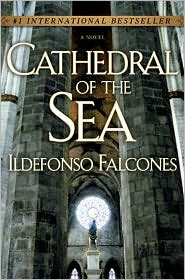
Cathedral of the Sea
Penguin Group
Reviewed by Elaine Simpson-Long
I was sent a copy of Cathedral of the Sea for review at Christmas time, but its 650+ pages and door stop size daunted me somewhat so I left it in my To be Read pile for a bit.
Mistake.
I picked it up a week or so ago and started to read and was immediately captivated. It had to be my reading-at-home-in-the-evening book as it just could not come on the commute; my arms would have been two inches longer by the time I carried this, plus all the other paraphernalia I cart backwards and forwards each day, but this week I gave in and took it with me on the train as I was enjoying it so much and could not wait to finish it.
This is a stonking good read. One of those huge, sprawling, historical epics full of colourful characters, glorious settings--in this case 14th century Barcelona--cruelty, lust, witchcraft and, just to make it even more exciting, the Spanish Inquisition. As I am visiting Barcelona this week and going to see Don Carlos, with its auto da fe and Spanish Inquisition scene, at the Royal Opera at the end of June, this piqued my interest even more.
Bernat and his son Arnau are two serfs who are on the run from the tyrannical rule of their feudal lord, who had raped Bernat's wife and stole his lands. They came to Barcelona where, if they lived for a year and a day, they could become free men and took refuge with Bernat's sister and her husband, neither of whom were happy to have them there. Arnau is a lonely child and one day comes across the church of Santa Maria in which is a statue of the Virgin of the Sea who he adopts as his mother. It is in this church and its surroundings that he receives friendship and love, growing up in its environs and becoming a bastaix, one of a band of men who carry the stone for the building of the new church from the local quarry and who are treated with respect by the citizens of the city.
To give you even a truncated version of the story of Cathedral of the Sea would still mean a mighty long review, so all I will say is that Arnau's journey from slave to nobleman is a fascinating one. He becomes rich and influential after catching the king's eye because of his courage in battle and is married to the king's niece Eleonore, who he does not love. His new found wealth and position, though justly earned, excites the jealousy of those who resent his rise and who begin to plot against him, bringing him into eventual conflict with the dreaded Spanish Inquisition.
What I love about historical novels is that they are always full of colour. Sometimes when I read contemporary fiction it appears to me in black and white, or pale colours. I know that sounds a bit eccentric but there it is, whereas books such as this one teem with vivid glorious shades of gold, amber, turquoise and purple, you can feel the heat of the sun, envisage the blue of the sea and the sky and almost warm yourself while you are reading. The language seems richer and vivid even when describing something as simple as different coins, the words just roll off the tongue:
"...the ones the Muslims use; bezants, mazmudinas, and gold bezants......French tournois, Castillian gold doblas, the gold florins struck in Florence and those minted in Genoa, ducats from Venice... reales from Valencia and Mallorcae, the gros from Montpelier."
And the clothes:
"He donned white sleevelss shirt made of hte finest Malines cloth trimmed with fur, a red silk damascene doublet came to his knees....black hose and black silk shoes. He fastened the doublet round his waist with a wide belt that had gold threads and was studded with pearls........then a marvellous black cloak...lined with ermine and embroidered with gold and precious stones."
Wonderful .
Quite often with books I am sent to review, when I have read them I pass them on to others to read and enjoy, but not this one. This is staying firmly on my bookshelves.